
The best automatic irrigation controllers of 2025 – Complete buying guide

- 1 Introduction: why choose an automatic irrigation controller
- 2 How an irrigation controller works – Simple explanation
- 3 Types of irrigation controllers: which one to choose?
- 4 What to evaluate before buying an irrigation controller
- 5 The best automatic irrigation controller models of 2025
- 6 Final conclusions: which irrigation controller to choose?
Introduction: why choose an automatic irrigation controller
Managing the watering of your garden, vegetable garden or even simple terrace plants can become a challenging task, especially in the warmer months. If you’re short on time or don’t want to risk forgetting to water, an automatic watering controller is the most convenient, efficient and smart solution.
These devices allow you to precisely schedule watering times, duration and frequency, avoiding waste and ensuring the right amount of water for your plants. In addition, many modern models offer smart features such as control from apps, integration with voice assistants (Alexa, Google) or the ability to suspend watering in case of rain.
Whether you are looking for a simple, manual control unit or a fully automated WiFi control unit, in this guide I show you the best models of 2025, selected for reliability, ease of use, and value for money. Plus, you’ll find practical tips for choosing the right model and installing it in minutes.
🔎 Find out now which automatic watering controller is right for you: read on and find the perfect model for your garden or balcony.
How an irrigation controller works – Simple explanation
An automatic irrigation controller is a device that allows you to control the water supply in your system in a programmed way and without manual intervention. It is the heart of any modern irrigation system, and is the difference between a “passive” system and a truly efficient and smart one.
🔄 The principle is simple:
The controller connects directly to the water tap or, in more advanced systems, to a dedicated water supply. From there, it controls the opening and closing of the flow to hoses, sprinklers or drippers, following a program set according to the needs of your green space.
⚙️ Main components and what they do
Timer or controller
This is the electronic part of the controller. In basic models it can be analog (with knobs), while in digital models you find a display and buttons for programming. More advanced versions can be managed by app via WiFi or Bluetooth connection.
Solenoid valve
This is the internal mechanism that opens or closes the water passage, according to the established schedules. In most models it is already integrated into the structure of the control unit.
Power
Control units typically run on AA batteries, but there are also versions with direct power supply or solar panel, which are ideal for continuous outdoor use.
Optional Sensors
Some models support rain or soil moisture sensors, which allow irrigation to be automatically stopped when not needed. This prevents water waste and makes the system even smarter.
📱 What about with smart controllers?
Smart controllers for automatic irrigation offer advanced features, ideal for those who want to manage everything remotely and precisely. With WiFi or Bluetooth models you can:
- Control the system from smartphones, even remotely
- Set custom programs for days and times
- Receive notifications in real time
- Integrate irrigation with weather data in your area
- Connect the control unit to Alexa, Google Home and other voice assistants
✅ Practical example
Set the controller to irrigate:
- Every day at 6:30 a.m.
- For a duration of 20 minutes
- Only if it has not rained in the last 24 hours (due to active sensor)
The result? A garden that is always watered at the right time, without waste, even when you are not at home.
Types of irrigation controllers: which one to choose?
There are different types of automatic watering controllers on the market, designed for different needs, spaces and levels of control. Knowing the differences will help you choose the right model for your garden, terrace or planting.
🔁 Mechanical control unit (analog)
It is the simplest and most straightforward solution.
It works with manual knobs that allow you to set:
- The duration of irrigation (e.g. 10, 15, 30 minutes)
- The frequency (once a day, every other day…)
Ideal for: terraces, small gardens, users who want something quick and technology-free.
Advantages: inexpensive, very easy to use, ready in 2 minutes.
Limitations: zero flexibility, no weekly scheduling or remote control.
📅 Programmable digital control unit
It has a small LCD display with buttons for setting:
- precise start times
- duration and days of the week
- Separate programs (in some models, even 2 independent lines)
Ideal for: users who want more precise management, without an internet connection.
Advantages: good compromise between price and functionality, weekly scheduling.
Limitations: sets up only locally, no app.
📱 WiFi or Bluetooth smart controller
It is the most advanced level. It connects to your smartphone via app, from which you can:
- create and edit programs in real time
- Check the status of irrigation wherever you are
- view usage statistics
- integrate the controller with weather services, voice assistants (Alexa, Google), rain sensors, IFTTT and other smart devices.
Ideal for: extensive installations, technology users, frequent travelers or those who manage multiple green areas.
Advantages: total control, remote management, optimized water savings.
Limitations: requires stable WiFi network, higher price.
In brief:
- Just want to automate without complicating your life? Choose a mechanical.
- Want more control but no app? A programmable digital one is perfect.
- Want the ultimate? Go for a smart control unit, manageable by app wherever you are.
What to evaluate before buying an irrigation controller
Before buying an automatic irrigation controller, it is important to consider some practical variables that will help you choose the best model for your actual needs. Here are the key points to consider carefully.
📏 Surface and structure of the plant.
- For small spaces such as balconies or terraces, a simple model with only one outlet is sufficient.
- For medium or large gardens, consider a controller with multiple lines (multi-zone) so that separate areas can be managed independently.
⏱️ Desired level of automation
Ask yourself how much freedom and flexibility you need.
If you just want a daily automatic start, a basic model is fine.
If, on the other hand, you are looking for more precise and customizable management (schedules, days, multiple programs), aim for a programmable or smart controller.
The differences between types are explained in detail in Section 3.
🔋 Power supply type
- Batteries: practical and easy to replace, ideal for outdoors.
- Electric cable: suitable for fixed installations in covered areas.
- Solar panel: low-maintenance solution for stable, self-contained installations.
🌦️ Sensor compatibility
Many models support rain or moisture sensors. If your plant is outdoors, it is worth choosing a controller that can stop watering when not needed-it will save water and extend the life of your plants.
🔧 Ease of installation.
Make sure that:
- the connection is compatible with your faucet (usually 3/4″)
- the connection with the pipes is simple
- the programming menu (or app) is intuitive
📱 Smart features (only if you really need them).
If you want to manage irrigation from your smartphone, remotely, or integrate the system with Alexa or Google Home, choose a smart model.
But if you prefer simplicity and reliability, a good digital timer is often more than enough.
A reasoned assessment today saves you problems tomorrow. Consider well the size of your system, how much you want to automate, and whether or not you need app control. That way you choose a controller that really fits your management style.
The best automatic irrigation controller models of 2025
Now that you have all the information to choose the right controller, it’s time to look at the best models currently available on the market.
We have selected them based on quality, functionality, ease of use, and value for money, including both simple timers and WiFi or Bluetooth smart controllers.
To help you choose, we have divided the power packs by price range, so you can easily compare the options that best suit your budget and needs.
🔹 Up to 30 € – Economic and functional solutions.
CROSOFMI Digital Automatic Watering Timer
A practical and waterproof digital timer designed for automatic watering of terraces, balconies and small gardens. It offers very flexible programming, from a duration of a few seconds up to several days. Easy to install, it resists the weather thanks to its IP65 certification.

Aqua Control C4099O Irrigation Controller
An essential but very functional analog model, perfect for those seeking simplicity and reliability. It sets up in seconds thanks to rotary switches and works even when there is no pressure, making it ideal for systems connected to cisterns or tanks.

CROSOFMI Garden Irrigation Control Unit
An excellent digital solution with LCD display, weekly programming and manual mode. Includes useful features such as child lock and rain delay. All in a compact and easy-to-install format, perfect for those who want more control without spending too much.

Aqualin Electronic Sprinkler Timer
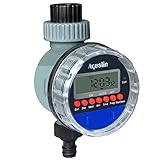
Versatile electronic timer, compatible with drip or sprinkler systems. It offers up to 8 programs and several weekly frequency options. Easy to set up and suitable for small do-it-yourself systems, it is one of the most complete solutions in this price range.
🔸 30 to 50 € – Entry-level digital and smart controllers.
Gardena Irrigation Computer Flex
A classic in its class, ideal for those who want precision and reliability. Allows you to manage short and frequent watering, perfect for pots and balcony plants. Easy to set up, compatible with Gardena moisture sensors, also has a manual “Water Now” function.

CROSOFMI WiFi Irrigation Controller
Designed for those who want to manage irrigation remotely, this WiFi controller allows you to create programs via app. Includes manual mode, rain delay and weekly scheduling. Great for medium-sized gardens.

CROSOFMI Bluetooth Irrigation Control Unit
Bluetooth version perfect for those who do not have WiFi in the garden but still want to use their smartphone to manage irrigation. Intuitive app, high water resistance, and smart features like rain pause complete the package.

⭐ Over €50 – Advanced control units for multi-zone management and smart
GARDENA Irrigation Computer with Bluetooth app
Smart controller that connects via Bluetooth to the Gardena app, ideal for controlling irrigations from smartphones in home gardens. Allows up to 3 independent programs and automatic suspension in case of rain. Easy to use and compatible with Gardena sensors.

Gardena Control Unit Classic 4030
Perfect for complex systems, this control unit manages up to 4 independent valves. It offers detailed programming directly from the front panel, and is compatible with rain and humidity sensors to optimize consumption.

Inkbird IIC-800-WiFi Irrigation Controller 8 zones
Professional solution for large gardens or vegetable gardens, allows management of 8 irrigation zones via WiFi and app. Includes features such as internal memory, manual mode and rain sensor, with intuitive interface for total remote control.

Final conclusions: which irrigation controller to choose?
Choosing the best automatic irrigation controller depends on several factors: the area to be managed, the frequency of use, the level of automation you want, and of course the budget.
If you are looking for a simple solution for balconies or small gardens, a mechanical or digital timer up to 30 € may be more than sufficient. For those with more structured needs, a
All the models I have shown you are selected for quality, reliability, and compatibility with major garden, terrace, or vegetable garden systems.
Now all you have to do is evaluate your needs and choose the most suitable controller-your greenery will thank you.
🔄 Return to the beginning of the guide or scroll through the product list to compare models.